
Pacific Spaceport Complex Alaska’s
Self-Guided Tour
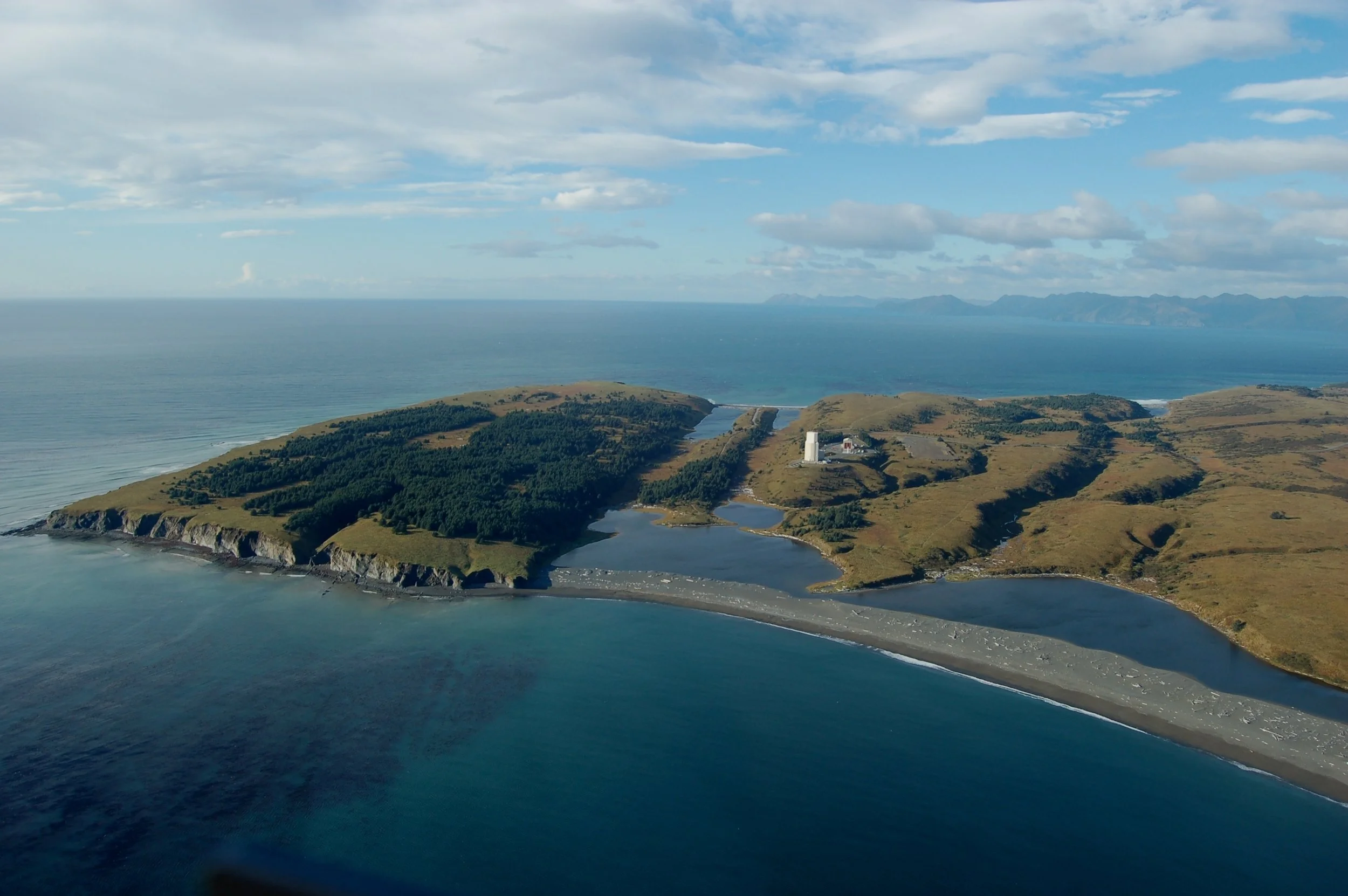
Welcome to a space designed for ideas that move people. You are visiting the nation's first FFA-licensed commercial spaceport—and one of the most distinctive launch sites in the world.
Operated by Alaska Aerospace Corporation, the Pacific Spaceport Complex Alaska, or PSCA, supports government and commercial aerospace missions from Kodiak Island. Its remote location and access to the open Pacific make Kodiak particularly well suited for launches into high-inclination and polar orbits.
PSCA is also an active working facility. As you explore, please remain on publicly accessible roads and areas, obey all posted signs, gates and closures, and do not attempt to enter restricted facilities. Operations may occasionally limit public access to portions of the site.
This self-guided tour follows the public road through the lower range and introduces some of the facilities and infrastructure that make a launch possible.
Jump to:
A Short History of AAC and the PSCA
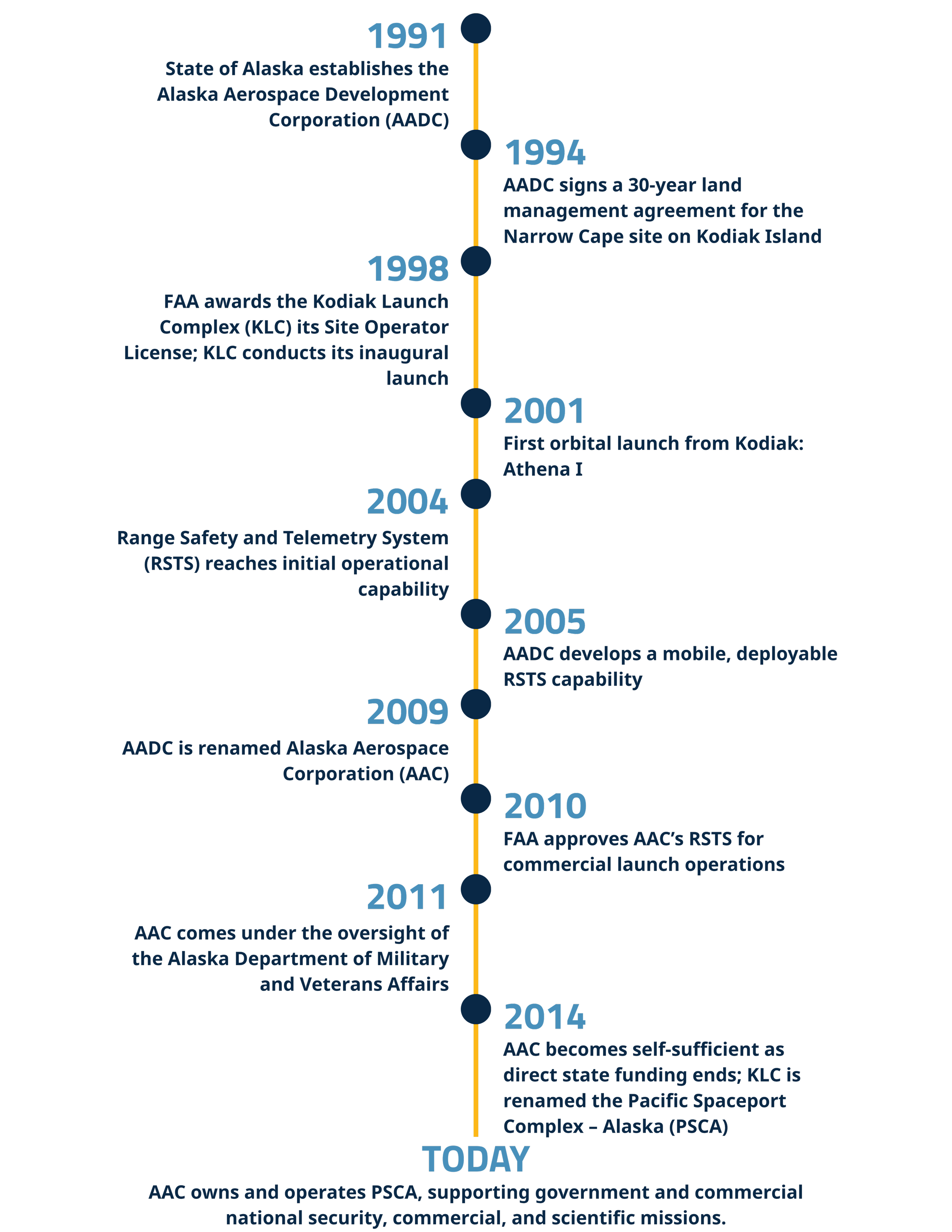
Alaska Aerospace began in 1991, when the State of Alaska established the Alaska Aerospace Development Corporation, or AADC, to develop aerospace opportunities in the state.
In 1994, AADC signed a 30-year Interagency Land Management Agreement with the Alaska Department of Natural Resources for the Narrow Cape site on Kodiak Island. Four years later, in 1998, the FAA Office of Commercial Space Transportation awarded the Kodiak Launch Complex, or KLC, its Site Operator License. That same year, the complex conducted its inaugural launch. The site's first orbital launch followed on September 30, 2001, when an Athena I rocket lifted off from Kodiak.
As operations expanded, Alaska Aerospace developed capabilities extending beyond the launch site itself. In 2004, its Range Safety and Telemetry System, or RSTS, reached initial operational capability, followed in 2005 by development of a mobile, deployable version of the system.
In 2009, the Alaska Aerospace Development Corporation was renamed Alaska Aerospace Corporation, or AAC. In 2010, the FAA approved AAC's RSTS for use in commercial launch operations.
In 2011, AAC came under the oversight of the Alaska Department of Military and Veterans Affairs. In 2014, direct state funding was terminated as AAC became self-sufficient, and the Kodiak Launch Complex was renamed the Pacific Spaceport Complex Alaska, or PSCA.
Today, AAC owns and operates PSCA as a commercial spaceport supporting government and commercial customers conducting national security, commercial, and scientific missions. Rockets have been launching from Kodiak since 1998, and PSCA remains the centerpiece of Alaska Aerospace’s launch operations, building on more than three decades of aerospace development while continuing to evolve alongside new launch vehicles, missions, and technologies.
Why Kodiak?
A launch site isn't chosen simply because there is enough room to build a launch pad. Where a rocket begins its journey affects where it can go.
Kodiak Island's location gives PSCA a broad, unobstructed launch corridor over the North Pacific Ocean. The spaceport can support launch trajectories between approximately 59 and 110 degrees of orbital inclination, providing access to high-inclination, polar and sun-synchronous orbits. The PSCA has the widest launch-azimuth range of any U.S. spaceport!
Why does that matter?
Satellites don't all travel around Earth in the same direction. Some orbit near the equator, while others travel at steep angles that carry them over much larger portions of the planet. Polar and sun-synchronous orbits are especially useful for missions that repeatedly observe Earth. A sun-synchronous satellite, for example, can pass over the same area at approximately the same local solar time on successive visits, providing more consistent conditions for observations.
Kodiak also offers several practical advantages for launch operations: low population density, manageable air and maritime traffic, a wide launch azimuth over the Pacific, year-round commercial air access, an ice-free port, and state-maintained road access.
Put simply, Kodiak combines something difficult to find: the right geography for reaching important orbits with the infrastructure needed to support complex launch operations.
How Does a Launch Happen?
A rocket launch may last only a few minutes, but a launch campaign can involve months or years of planning and preparation.
Every mission is different, but a campaign at the PSCA generally brings together many of the same activities. Alaska Aerospace supports customers throughout the launch lifecycle, including mission planning, engineering, regulatory compliance, safety, instrumentation, payload processing, vehicle integration, weather support, range operations, emergency response and post-launch analysis.
From Mission Plan to Liftoff
Plan the Mission
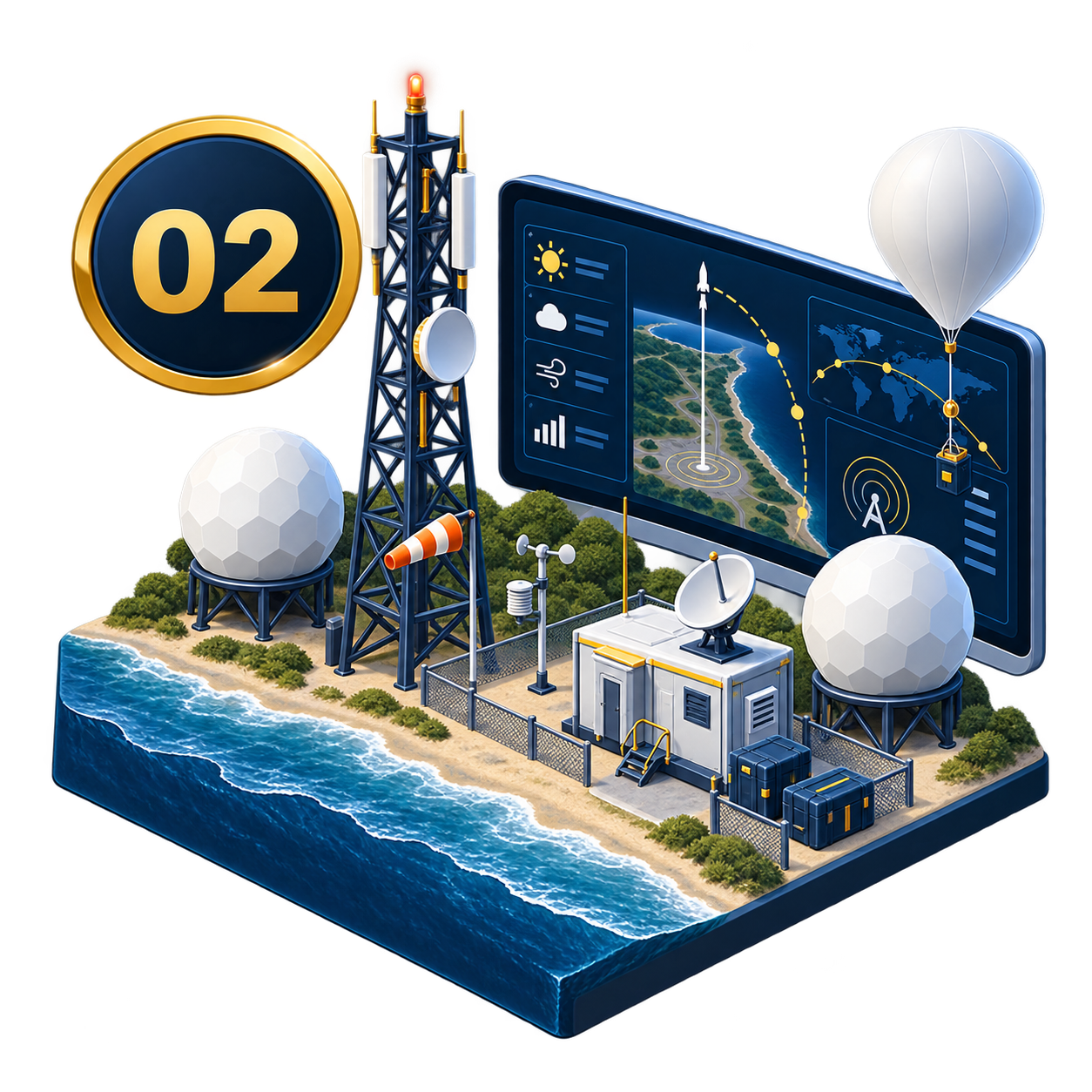
PSCA personnel prepare the facilities, communications, instrumentation, weather systems and other range capabilities needed for that particular mission. Because Launch vehicles and missions vary, the range must be able to adapt from one campaign to the next.
Components are assembled and integrated according to the customer's mission plan. Testing and verification continue throughout the process to ensure systems are ready for flight.
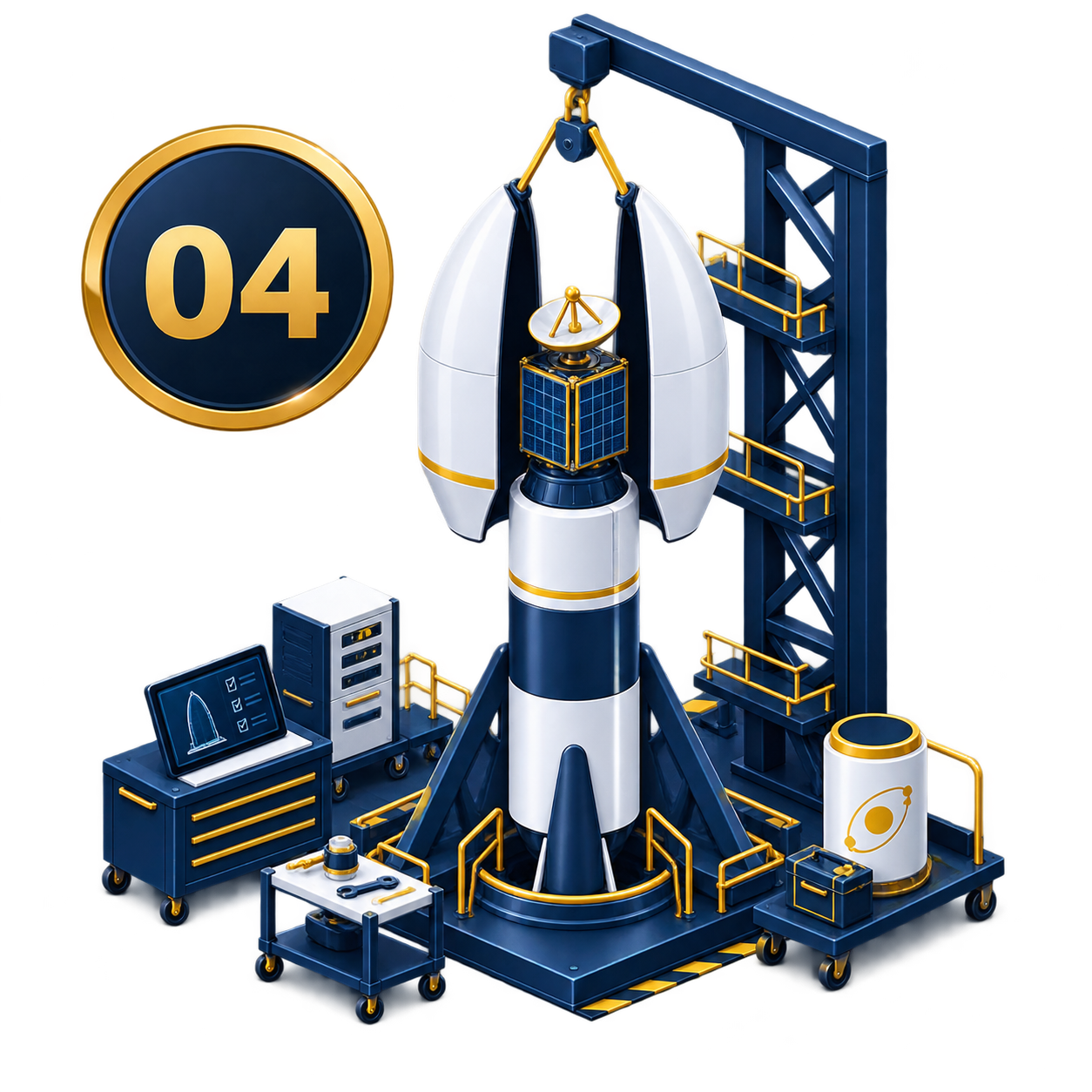
Integrate the Vehicle & Payload
Get Ready to Launch
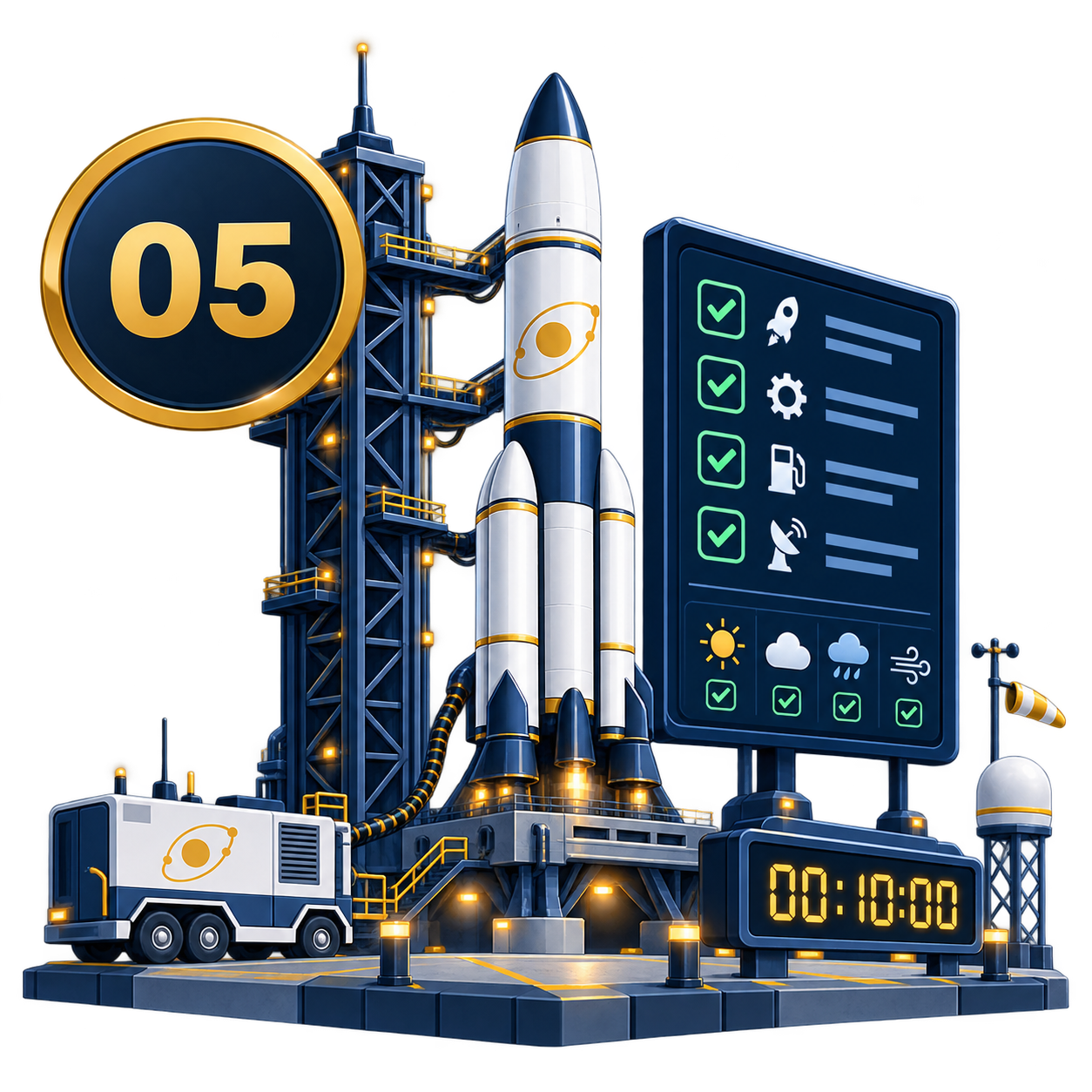
As launch day approaches, teams evaluate vehicle readiness, range status, weather, safety requirements and other conditions. A launch proceeds only when the required systems and organizations are ready.
Long before hardware arrives in Kodiak, teams determine the mission's requirements, schedule, launch trajectory, facilities, staffing and support needs. Regulatory, safety, and operational requirements are incorporated into the plan.

Prepare the Range
Receive & Process the Hardware
Launch & Monitor the Flight
During the countdown and launch, range personnel monitor the mission using communications, weather, instrumentation and other systems across the PSCA. The rocket leaves Kodiak and follows its planned trajectory over the Pacific.

Launch vehicles, payloads and supporting equipment arrive at the PSCA and are prepared in specialized facilities. The customer’s teams inspect, test and configure the hardware before it moves farther through the launch process.

Work doesn't stop at liftoff. Teams secure facilities, review mission data, recover or remove equipment as required and complete post-launch activities before the range transitions to its next mission.

Close Out the Mission
As you continue through the PSCA, many of the buildings and areas you'll see support one or more of these steps.
Frequently Asked Questions
-
The Pacific Spaceport Complex – Alaska is an FAA-licensed commercial spaceport located at Narrow Cape on Kodiak Island. It is owned and operated by Alaska Aerospace Corporation and supports vertical rocket launches for government and commercial customers.
-
Alaska Aerospace Corporation is a State of Alaska-owned corporation established in 1991. Although it is a state entity, it receives no state funding. AAC operates commercially and earns revenue by providing launch and aerospace services to its customers.
-
The PSCA supports government and commercial customers conducting national security, commercial, and scientific missions. The spaceport has supported both suborbital and orbital launches since operations began in 1998.
-
Different launch sites are suited to different types of orbits. Kodiak's location and its open launch corridors over the Pacific make PSCA particularly well suited for high-inclination, polar and sun-synchronous trajectories.
Kodiak also offers an operational advantage. Many launches in the Lower 48 are concentrated at heavily utilized federal ranges, where increasing launch activity can create competition for range time, processing facilities and other support resources. The PSCA provides an alternative launch location with greater scheduling flexibility and the ability to support missions on a more customer-driven schedule.
Together, Kodiak's geography, relatively uncongested operating environment and flexible range make the PSCA a valuable option for missions that don't need to launch from a lower-latitude site.
-
An orbital mission places a spacecraft or other payload on a trajectory that allows it to travel around Earth. A suborbital mission travels into or toward space but does not enter a sustained orbit around Earth.
The PSCA has supported both types of missions.
-
The PSCA is the spaceport, not the rocket manufacturer. Launch customers bring their vehicles and mission hardware to Kodiak. Alaska Aerospace provides the facilities, range capabilities, personnel and services needed to help customers prepare for and conduct their missions.
-
The launch pad is only the final stop in a much larger process. Rockets and payloads may need to be received, stored, inspected, assembled, integrated and tested. At the same time, other teams are working on weather, communications, range safety, instrumentation, logistics, and mission control.
That's why much of what you'll see during this tour isn't a launch pad at all—it is the infrastructure that makes the launch possible.
-
Public access and viewing opportunities depend on the individual mission and the safety restrictions in effect at the time. Roads and areas that are normally accessible may be temporarily closed during launch operations.
Check Alaska Aerospace's current public notices before traveling to Narrow Cape for a launch.
-
No. This self-guided experience is intended for visitors traveling through publicly accessible areas. Operational facilities, gated roads, and restricted areas are not part of the self-guided tour.
Please remain in permitted areas and follow all posted signs and instructions.
-
Fossil Beach is publicly accessible under normal conditions, but access may be restricted when spaceport operations require temporary closures. Follow posted signs and current access information during your visit.
-
Not necessarily. The PSCA is a working facility whose infrastructure supports many different activities. Some areas are dedicated to launch operations, while others provide maintenance, storage, construction, customer workspace, logistics, or other mission support.
The next section will introduce the major facilities and areas you'll see as you travel through the lower range.
What You’ll See

-
One of the first major facilities you'll encounter is the Range Control Center, located across the road from Rocket Park.
During mission operations, this area helps bring together the people, systems, and information needed to safely conduct activities across the range. A launch requires much more than the rocket itself. Teams must coordinate communications, weather information, range activities, schedules, and mission requirements before a vehicle can be cleared to launch.
Nearby is the Weather Balloon Building. Weather is a critical part of launch operations, and atmospheric data helps mission teams understand conditions both at ground level and higher in the atmosphere.
Kodiak's weather can change quickly, making meteorological monitoring an important part of operations at the PSCA.
-
The Alpha Site provides additional workspace that can be made available to customers supporting missions at the PSCA.
Launch campaigns can bring teams, equipment, and specialized requirements to Kodiak for extended periods. Flexible work areas such as the Alpha Site allow the spaceport to adapt its facilities to the needs of individual missions.
-
The Maintenance Support Facility, or MSF, supports the ongoing work required to keep a remote launch complex operating.
A spaceport depends on much more than launch infrastructure. Buildings, vehicles, antennas, electrical systems, communications equipment, and other supporting infrastructure must remain operational in an environment that can include strong winds, salt air, rain, snow, and rapidly changing weather.
Beyond the MSF is the Instrumentation Field. Some of this equipment may be difficult to see from the road, but instrumentation systems play an important role in collecting information and supporting range operations during missions.
-
As you continue through the site, you will pass turnoffs serving Area 1 and Burton Road.
Area 1 is one of several designated operational areas located throughout the PSCA.
Burton Road is a public road that leads toward Narrow Cape Lodge, which can provide lodging for mission personnel supporting operations at the PSCA. Its location near the launch complex allows visiting teams to stay close to their work during launch campaigns.
-
The Payload Processing Facility supports one of the most important parts of a launch campaign: preparing mission hardware before launch.
Payloads can require specialized handling, inspection, preparation, and testing before they are integrated with a launch vehicle. Facilities such as this allow mission teams to perform that work in an ISO-rated cleanroom environment at the spaceport.
Closer to the road, the water tower is one of the more recognizable landmarks at the site and supports the infrastructure needed to operate a complex of this size in a remote location.
-
Area 4 is a gravel pad that can provide additional space for mission personnel and mission-support activities.
Areas like this may look simple compared with the PSCA's larger buildings, but flexible open space is valuable during launch campaigns. Missions can bring temporary equipment, vehicles, support systems, and personnel with requirements that vary substantially from one customer to another.
-
Area 2 is another gravel operational pad. The PSCA's combination of permanent facilities and configurable gravel pads allows the range to support missions with very different requirements without every activity needing a dedicated launch pad.
-
A turnoff along the route leads to the Rocket Motor Storage Facility.
Launch vehicle components require specialized handling and storage, and dedicated facilities allow certain hardware to be managed separately from other mission-processing activities.
For safety and security reasons, visitors should remain on the public roadway and should not approach this facility.
-
Area 5 is another gravel area, currently used primarily to provide flexible space for construction storage and other support requirements.
Facilities at the PSCA continue to evolve as the spaceport adapts to new missions, customers, and infrastructure needs.
-
As you reach the lower portion of the range, you'll encounter one of the most recognizable areas of PSCA: Launch Pad 1, or LP1.
This complex includes several facilities supporting launch vehicle preparation and launch operations.
The Integration Processing Facility, or IPF, provides space associated with preparing and integrating launch hardware.
Nearby is the Spacecraft and Assemblies Transfer Building, commonly referred to as SCAT, along with the iconic Launch Support Structure, also known as the Tower.
Together, facilities in this area illustrate an important point about spaceflight: launch day is only the final step in a much longer process.
Before a vehicle reaches the pad, mission teams may spend weeks, months, or longer receiving equipment, preparing hardware, testing systems, integrating components, reviewing weather and range conditions, and completing safety and readiness checks.
Only after those preparations are complete does the mission move toward launch.
-
A separate turnoff leads toward Area 3, which includes four gravel and concrete pads.
Like the other configurable areas throughout the spaceport, these pads give the PSCA additional flexibility to support mission equipment, temporary infrastructure and customer-specific requirements.
The exact use of these areas can change from mission to mission.
-
Near the end of the public route is the turnoff for Fossil Beach, a publicly accessible beach overlooking the Pacific Ocean.
The coastline provides a striking reminder of one of the reasons this site exists here.
The PSCA's location on Kodiak Island places launch operations adjacent to a vast expanse of the Pacific Ocean. That geography provides access to launch trajectories that make Kodiak particularly useful for missions traveling into high-inclination and polar orbits.
It also places a modern aerospace facility in the middle of one of Alaska's most distinctive natural environments.
Visitors traveling to Fossil Beach should remember that conditions and access can change during spaceport operations and should always follow posted signs and closures.
More Than a Launch Pad
What you've seen along this road represents only part of what it takes to operate a spaceport.
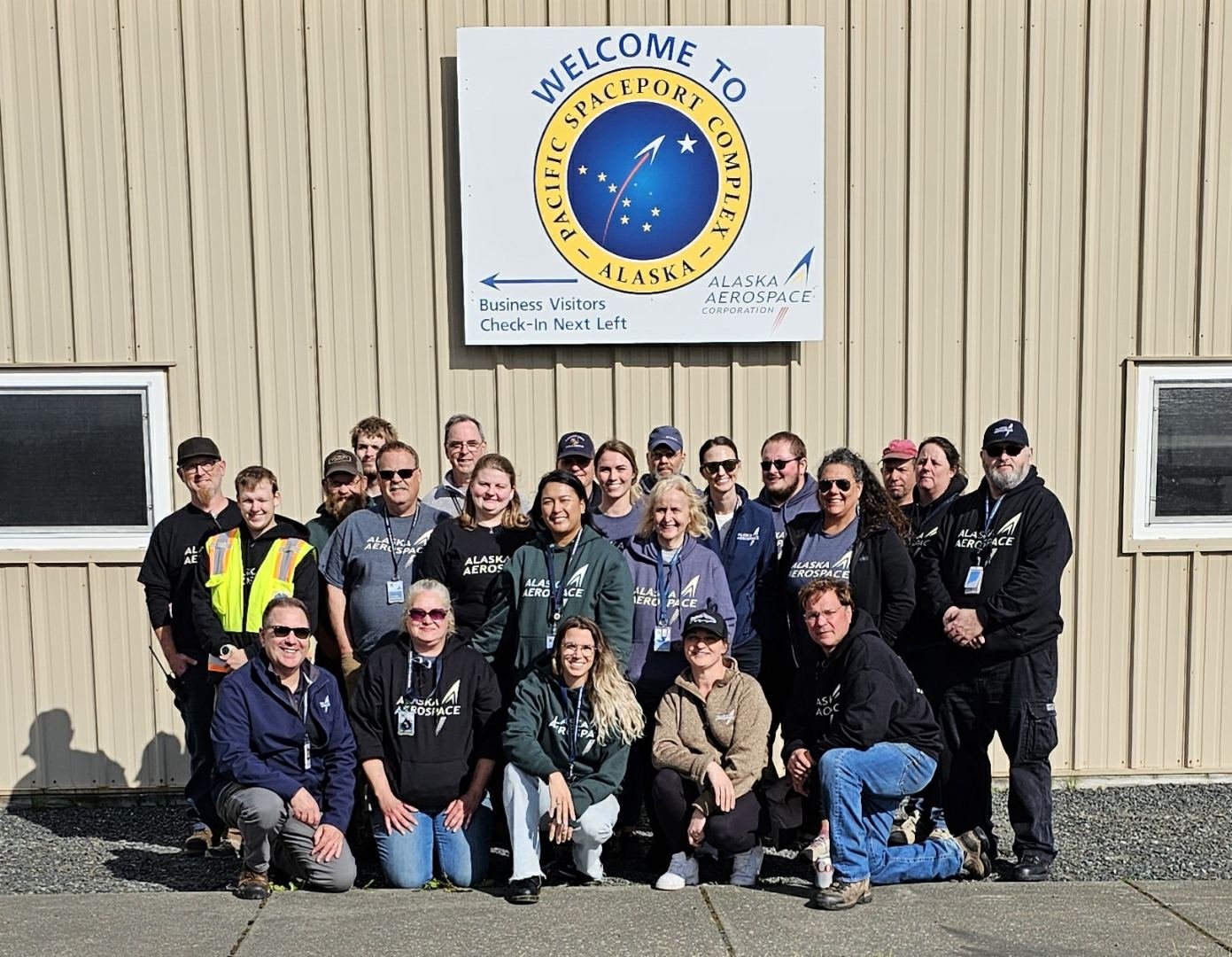
Every mission involves teams working across engineering, range operations, weather, safety, communications, logistics, maintenance, facilities, security, and mission management. Much of that work begins long before a rocket arrives at the PSCA—and continues until well after launch.
The result is something unusual: a working spaceport on the edge of Kodiak Island, connecting Alaska directly to missions operating far beyond it.